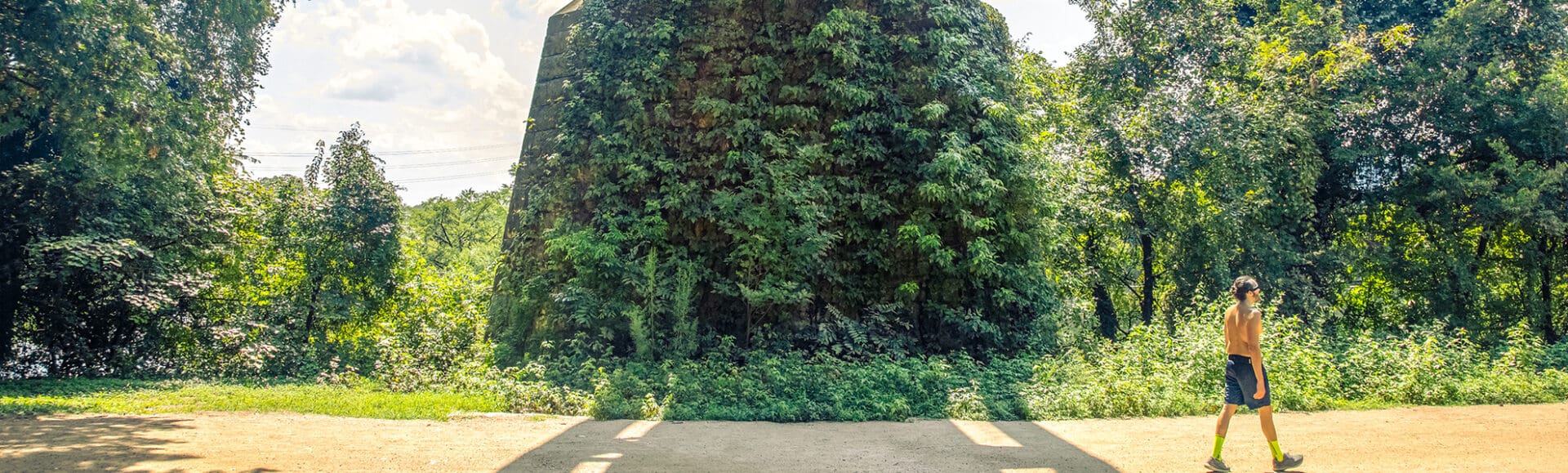
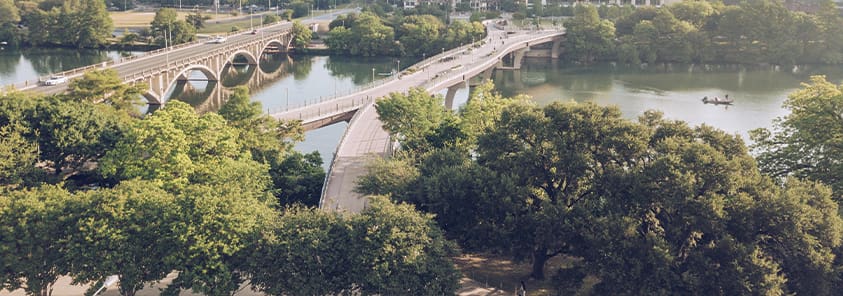
In the heart of Austin sits the Ann and Roy Butler Hike-and-Bike Trail at Lady Bird Lake, a lush, urban path nestled along the water’s edge, passing by skyscrapers, neighborhoods, ball fields, and parkland. With more than 5 million visits a year, the 10-mile hike-and-bike Trail is Austin’s most recognized and popular recreational area. But it wasn’t always like this. Explore the history of the Butler Trail and see how one idea can transform an entire city.
History of the Butler Trail
1959-2026
Floods, Dams, and Electricity
In the 1960s, Austin’s Colorado River banks were nothing like the lush oasis they are now– the area was nearly barren. Flooding was Austin’s greatest natural foe. Between 1893 and 1912, several dams that once stood on the site of the existing Tom Miller Dam were built and lost due to massive floods that also swept away trees and vegetation lining the river. The vibrant, tree-lined shores of today exist because of the stability introduced by damming the river.
In 1959, as Austin grew in population, so did electric demand. The only recently completed Seaholm Power Plant did not have the capacity for more units to keep up with the demand, so Austin needed another power plant. Land was available in the Holly Neighborhood, but there was no source of cooling water for a future power plant, so it was time for Austin to build another dam too. The still standing Longhorn Dam created a lake providing a reservoir of cooling water, but it also created a lake through Austin and what is now the eastern end of the Butler Trail.
The Vision
During the 1970s, the banks of Lady Bird Lake were polluted, barren, and covered with weeds. It took the vision of Lady Bird Johnson—the wife of former President Lyndon Johnson—and Ann Butler—the wife of former Austin Mayor Roy Butler—to create the Trail we know an love today.
In 1971, After a trip to Switzerland for the International Conference of Mayors, Mayor and Mrs. Butler decided to pass through London before returning to Austin. While in London, Mrs. Butler met with Lady Bird Johnson at their hotel. The two women were admiring a stretch of the Thames Path—a beautiful, green trail—from the balcony when Mrs. Johnson asked Mrs. Butler if something like it could be created along Austin’s Town Lake. The answer was yes.
The Value of Beautification
In 1971, the Town Lake Beautification Committee, a unique public-private civic effort for a “more beautiful Town Lake,” was formed. The Committee included many notable Austin citizens, including honorary chair Lady Bird Johnson, Les Gage, Ann Butler, Carolyn Curtis, Emma Long, Betty Wilson, and Jim Pfluger, among others. In cooperation with Mayor Roy Butler, the committee set out to create a scenic corridor of hiking trails and landscaping that would allow residents and visitors the opportunity for a rural escape in an urban setting.
On that balcony, Mr. and Mrs. Butler and Mrs. Johnson came up with the idea of the Committee’s largest fundraiser at the LBJ Ranch that would take place in 1973. Mrs. Butler even persuaded Texas International to fly significant donors to the LBJ Ranch from Houston. Additionally, Mrs. Butler personally enlisted the services of all of Austin’s garden clubs to help with the maintenance of the beautification project, allowing them to adopt portions of the Trail, grow seasonal plants and maintain sprinklers.
A Legacy that Lives On
Decades after its birth, the Trail stands as a testament to the vision and hard work of many individuals and the support of the citizens of Austin. In 2003, the Town Lake Trail Foundation (now The Trail Conservancy) was formed to continue the work of the Citizen’s Committee and ensure that the Trail remains one of Austin’s outstanding places for the benefit of all. In 2007, following the death of Lady Bird Johnson, Town Lake was renamed Lady Bird Lake, and in 2011, the Town Lake Hike-and-Bike Trail was renamed the Ann and Roy Butler Hike-and-Bike Trail. The Trail Conservancy’s resolve is to see that their work is carried forward for generations.
The work of The Trail Conservancy is to protect a natural setting where healing, joy, and connection occur daily. The Butler Trail supports our community’s mental and physical health, allows for recreation and mobility, and is a place where humanity, generosity, and equity are exalted.